yellow star
Diary of Anne FrankThe yellow star is a compulsory marker of Jewish identity and one of the diary’s most visible signs of persecution. In Anne Frank’s account, it turns discriminatory law into something carried on the body: it distinguishes Jews in public, speaks for itself to onlookers, and makes the restrictions surrounding everyday life impossible to ignore. Its meaning deepens across the diary, from an imposed badge to a focus for reflection on collective identity and belonging.
A mark imposed by law
After the German occupation of the Netherlands, a series of anti-Jewish decrees narrowed Jewish life through restrictions on movement, shopping, transport, education, recreation, and contact with non-Jews. The requirement to wear a yellow star stood among these measures. Anne recalls the decrees as a catalogue of prohibitions and obligations: Jews could not ride streetcars or use their own cars, had to shop between three and five in the afternoon, and faced a night curfew, among many other restrictions. The star gave this legal classification a public form, while the rules around it made clear that discrimination governed ordinary routines as well as public identity.
The family’s earlier anxieties had already been shaped by persecution beyond the Netherlands. Anne writes that relatives in Germany suffered under Hitler’s anti-Jewish laws; after the 1938 pogroms, her two maternal uncles fled to North America, and her elderly grandmother came to live with the family. Against that history, the star belongs not to an isolated episode but to a widening pattern of danger and imposed separation.
Visible in the departure for hiding
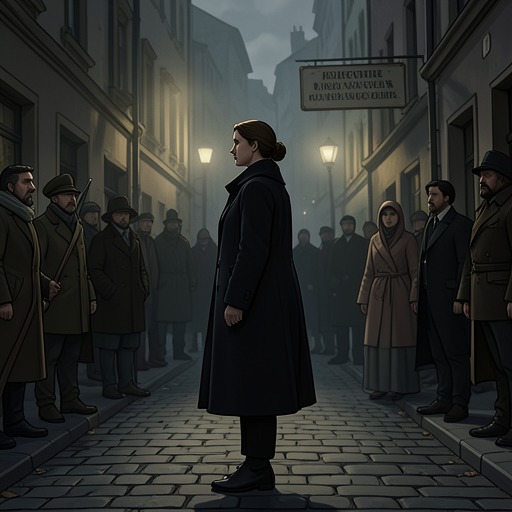
When Anne’s family left their home for the hiding place in her father’s office building, they walked through pouring rain carrying schoolbags and shopping bags. People going to work looked at them sympathetically, but could offer no transportation; Anne understood that the conspicuous yellow star spoke for itself. In this scene the badge functions as a public signal of the family’s predicament. It identifies them even as they try to move toward concealment, making visible the persecution that has forced them to disappear.
The departure also gives the star a striking contrast with the family’s preparations. Their plan to go into hiding had been set for July 16, but Margot’s call-up notice moved it forward by ten days. They had already been moving furniture and clothing out of the apartment, and now had to leave with what they could carry. The star does not explain the whole danger, but its presence makes the family’s vulnerability legible to strangers in the street.
Identity, faith, and belonging
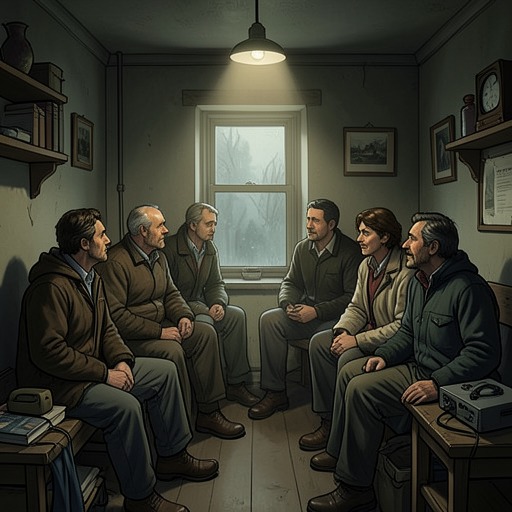
In the Annex, Jewish identity appears not only as a category enforced by the occupiers but also as a shared life maintained under constraint. For Hanukkah, the residents exchanged a few small gifts and lit candles for only ten minutes because candles were scarce; Mr. van Daan made a wooden menorah. The modest observance shows how religious practice continued within the limits of hiding. The star itself is not described as part of this celebration, but the contrast is telling: Jewish life persists in forms the residents choose, while the public badge belongs to the system that marks them from outside.
Anne later names the political force behind that marking. After a security scare, she writes that the residents have been reminded they are Jews in chains, confined to one place, without rights and burdened with obligations. Yet she insists that they must remain brave and trust that the war will end, when they will be people again and not just Jews. Her words hold together two realities: Jewish identity cannot be wished away under persecution, but the reduction of a person to that identity is itself an injustice.
That tension continues in Anne’s response to reports of growing antisemitism in Dutch circles. She considers accusations that Jews under German pressure betray helpers, asking whether Christians would necessarily act differently in the same circumstances. She is especially troubled by talk that German Jews who had immigrated to the Netherlands before the war, and were later sent to Poland, should not be allowed to return after Hitler’s defeat. The yellow star’s imposed distinction thus resonates beyond the moment of wearing it: even the prospect of liberation does not guarantee that Jews will be accepted as equal members of the society that sheltered them.
The star and the hope of home
Anne’s attachment to the Netherlands survives this disillusionment. She says she loves the country and had hoped it would become a fatherland after she had lost her own; despite the threat that Jews might be forced to leave, she still hopes it can. The star and the language of home therefore point in opposite directions: one assigns an exposed, excluded identity, while the other expresses a continuing claim to belonging.
Across the diary, the yellow star links legal restriction, public visibility, and Anne’s changing reflections on Jewish identity. It makes persecution concrete in the street, where strangers can recognize the family’s plight but cannot transport them to safety; later, it belongs to a broader struggle over who may claim rights, return, and a home. Its significance lies in that unresolved contrast between being marked as different and insisting on a common human life.